Time Hunter
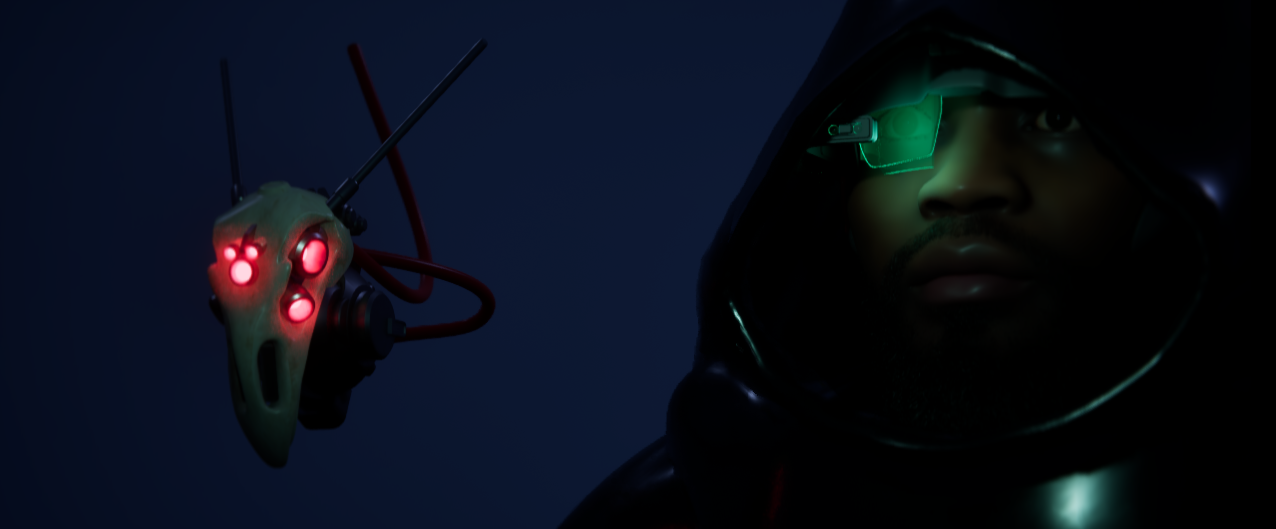
Status: In production
Verité footage grounds the film in my daily life — long commutes on Berlin's cold streets, open-mic performances in cramped clubs, and phone calls home to reassure my mother as she faces housing insecurity. These real-world stakes underscore the film's nonfiction spine: a migrant balancing survival and assimilation in Europe while sustaining family back home. Interwoven are memories of Namibia — its warmth, music, and communal life — contrasted with the isolation of Berlin.
By day, I work as a creative technologist, researcher, and musician. By night, I channel my philosophies around technology and revolution into lyrical performance, where my alter ego — the Time Hunter — emerges as a speculative agent on a quest to decolonize technology used to maintain imperial control of time and space.
Born in a war camp, I spent my post-apartheid childhood grappling with colonialism, racism, and war by disappearing into sci-fi comics, video games, and sciences. "I perform different characters," I reflect. "It's how the brain of a child copes in the face of trauma — it imagines a different state." This shapeshifting has followed me into adulthood, where multiple identities now serve as tools of resistance.
The Research
As a researcher with Forensic Architecture, I investigate how the Germans built a network of towers that used early wireless communication to connect Berlin and Windhoek. This technology enabled the first genocide of the 20th century against the Nama and Herero, and later laid the foundation for Apartheid and neocolonial extraction. Long since destroyed, I grew up in the same neighborhood where the ruins of those towers still remain.
My colleagues and I model colonial-era Namibia in hyperreal detail. These reconstructions document atrocity with vivid accuracy and create virtual environments where speculative sequences unfold. Here, the Time Hunter confronts the past, and utilizes the towers as gateways to alternate futures, where he can disrupt colonial continuities.
Ancestor A.I.
Threaded throughout the film is the voice of Ancestor A.I., a narrator inspired by my writings on African Accelerationism. Channeling ancestral wisdom and diasporic memory, Ancestor A.I. guides the Time Hunter through The Capital and the dislocations of the diaspora, offering strategies of survival and disruption, grounding the journey in a continuum of resistance.
The speculative thread is used sparingly but with high impact: sequences where my research bleeds into my performance as the Time Hunter are rooted in factual investigations, testimony from descendants of survivors of Germany's colonial violence, and archival evidence — ensuring that imagination heightens rather than obscures the documentary core.
The Signal
Through my music, art, and tech, I broadcast resistance via a concept album and underground radio show, challenging the myth of white futurity and urging technology's reimagination as a tool for sovereignty and collective care. While following the signal through different virtual landscapes in time, the Time Hunter eventually traces the source back to the present — a still-operational wireless transmitter station on the outskirts of Berlin.
Convergence
The dual narratives converge in the final act. Just as the Time Hunter's mission to dismantle the Colonial Core seems within reach, the struggle to integrate into German society takes its toll. I am hospitalized with Time Travel Sickness — a metaphor for the psychosomatic rupture of diaspora — reflecting the toll of being severed from home, family, and history. Suspended in a fever dream, I glimpse fragments of the colonial past, utopian futures, and lived experience.
In one core memory, I am back in Namibia with family and community. Here, I am reminded that the struggle against colonialism is not only achieved through armed resistance or technological sabotage, but also through collective care and trust. Following Ancestor A.I.'s directive, I implant a computer chip into my arm — accelerating the union between Black Africans and the machine.
Returning to Namibia, I present my research before community members and traditional authorities, not only recounting history but proposing strategies for utilizing technology for collective use. This moment re-centers the voices of those most impacted, transforming research into a tool of accountability and sparking dialogue about reparations, justice, and the possibilities of technological liberation.
Reconnecting with fellow technologists and artists, I explore ways of democratizing tools once designed for control, transforming them into resources for community resilience, collective power, and a decolonial future.